
Roof Maintenance Checklist for Homes in Tampa, FL
Your roof is fundamental in protecting you from Tampa’s intense storms, hot summer days, and high humidity. Tampa’s changing weather …
February 6, 2026
7 MIN READ

Homeowners know the reality of living through Ohio's weather events, with thunderstorms, windstorms, and hailstorms striking regularly, leaving roofs battered and vulnerable. When you discover shingles torn away or water pooling in your attic, your first priority as the policyholder is to assess the urgency and the time limits you have to protect your roof insurance claim in Ohio and maintain financial protection.
Ohio laws, insurance policy language and insurance claim deadlines create a maze that can mean the difference between approved coverage and costly denial. Understanding roof damage claim rules, when to report storm damage, when to file your claim and how state regulations apply gives you the power to act confidently, navigate complex policy terms, and secure the financial protection you need — especially when trusted roofing expertise supports you through the appraisal process.
When you wonder how long you have to file a roof claim, the answer depends on insurance policy clauses and state regulations. Both create overlapping time frames that determine your storm damage claim filing period.
Your insurance policy functions as a binding contract with specific notification requirements. Most policies require prompt notification after discovering storm damage, though what constitutes reasonable isn't always defined in terms of a particular number of days. The proof of loss requirement typically gives you 60 to 90 days after the insurer requests it to document your claim with detailed evidence.
State regulations add another layer through Ohio insurance laws that protect homeowners and establish minimum standards. Your homeowners insurance claim period may have varied policy language compared to others, but the Ohio Administrative Code 3901-1-54 requires insurers to acknowledge claims within 15 days and make coverage decisions within 21 days after receiving your proof of loss. These legal requirements in Ohio create a floor below which your insurer cannot go.
The statute of limitations governs how long you have to file a lawsuit if your claim is denied. For breach of contract cases, you have six years from the date of loss to take legal action. This limit changed from eight years in 2021. When the discovery date differs significantly from the date the damage occurred, these distinctions are important for maintaining your policyholder rights.
Standard claim windows in Ohio vary widely depending on your insurer and policy type.
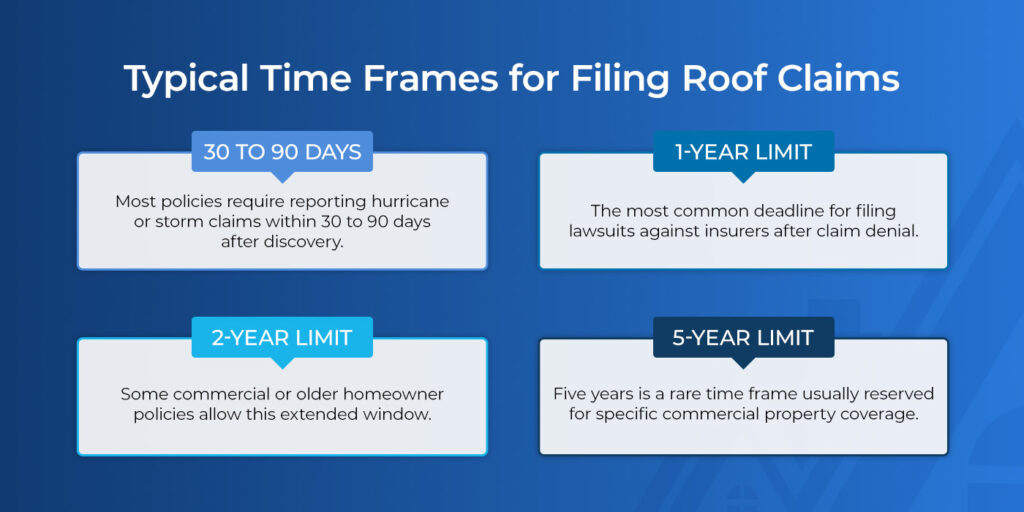
Common time frame structures include:
The challenge stems from policy language that defines filing differently. Initial notification to your insurer is one deadline. Submitting formal proof of loss with complete documentation is another. The statute of limitations for legal action represents yet another timeline.
Ohio insurers' policy variations mean your neighbor's policy might have entirely different deadlines, even if you experienced identical hail damage from the same storm. Catastrophic events like widespread windstorms can trigger special provisions, though these aren't guaranteed. Some policies include extended filing deadlines after emergencies, while others maintain standard timelines.
Your specific policy language controls your deadlines, but it cannot override state law minimums. Always read your declarations page carefully.
Understanding the difference between these dates can determine whether your claim remains valid months after a storm. The date of loss marks when damage occurred, such as the day a hail storm pummeled your roof or when a windstorm tore away shingles. The date of discovery marks when you first became aware, which matters for hidden damage.
An Ohio Supreme Court ruling established that homeowners who discover concealed damage well after a storm may still file valid claims. In that case, hidden damage found later remained eligible because the discovery date controlled the timeline.
Your insurance adjuster will evaluate circumstances and apply policy interpretation guidelines to determine which date governs your filing deadline, protecting your claim validity.
Major weather events that trigger emergency declarations can occasionally extend filing windows, though homeowners shouldn't rely on automatic extensions. When severe tornadoes or flooding overwhelm communities, some insurers extend deadlines to accommodate the massive claim volume adjusters must process.
Disaster claims may receive extended deadlines or disaster relief provisions depending on your carrier's policies. Ohio-specific provisions vary by company. Some automatically extend all deadlines during declared emergencies, while others maintain standard time frames unless you request an extension.
Always confirm your specific deadline with your insurer after major storms rather than assuming extra time.
A claim denial is more likely once your filing period expires — insurers have contractual grounds to reject your request regardless of how legitimate the damage is.
Coverage forfeiture means you lose your right to receive insurance benefits for valid storm damage. If you have a timeline policy breach due to a claim delay on your side, this gives your insurer legal justification to close your case without payment, leaving you to shoulder the entire financial burden. Out-of-pocket expenses for roof replacement will vary depending on the type of material, the size of your home and other factors.
The dispute process offers limited options once deadlines pass. You can file a complaint with the Ohio Department of Insurance, which may investigate if your insurer acted improperly. However, if you missed clearly stated deadlines, regulatory intervention and legal counsel rarely reverse decisions. Legal recourse through courts faces similar challenges since judges typically uphold policy deadlines absent evidence of bad faith.
The financial burden extends beyond immediate repair costs. A damaged roof compromises energy efficiency, allows water intrusion that leads to mold and structural decay and reduces property value. Understanding your specific deadlines and acting promptly protects both your home and your financial security.
Taking immediate action after discovering roof damage protects both your property and insurance rights. Follow these essential steps:
Ohio's weather considerations make swift action critical. The state's frequent temperature swings, freeze-thaw cycles and recurring storms mean that minor damage can rapidly escalate. Emergency repairs prevent additional losses. Always document the original condition first. Keep all receipts for materials, as these costs are typically reimbursable.
When questions arise about your rights and deadlines, knowing where to find accurate information becomes essential. The Ohio Department of Insurance serves as your primary resource for consumer protection information, complaint filing and guidance on state insurance requirements.
Local laws may impose additional requirements beyond state regulations. A policy review with your agent or a qualified professional ensures you understand how these apply. Seeking insurance agent advice helps clarify policy-specific deadlines and filing procedures your carrier requires.
For complex situations involving disputed deadlines or denied claims, legal consultation will provide critical guidance. Accurate information matters immensely in time-sensitive situations. Generic online advice may not reflect Ohio-specific claim rules or your insurer's requirements.
Roofing contractors with extensive insurance claims experience are the easiest immediate option, rather than trying to figure things out yourself or going through layers of bureaucracy.
When storm damage threatens your home, it's your responsibility as a homeowner to get it fixed. You don't need to do this alone. Lifetime Quality Roofing and Exterior Services is here to help you navigate your insurance coverage and file timely claims. Lifetime Quality combines deep insurance policy knowledge with compassionate support, giving you a trusted partner who understands regulations and the stress homeowners face after roof damage.
Our team provides thorough documentation, works directly with insurance adjusters and helps you meet every critical deadline as well as give you tips to prepare for the next batch of Ohio weather. From your first free consultation through final repairs, we stand beside you with the knowledge and advocacy that turn uncertainty into confidence.
If you're ready to protect your home and your claim, book your free consultation to experience the peace of mind and roof damage protection that comes from expert partnership.